



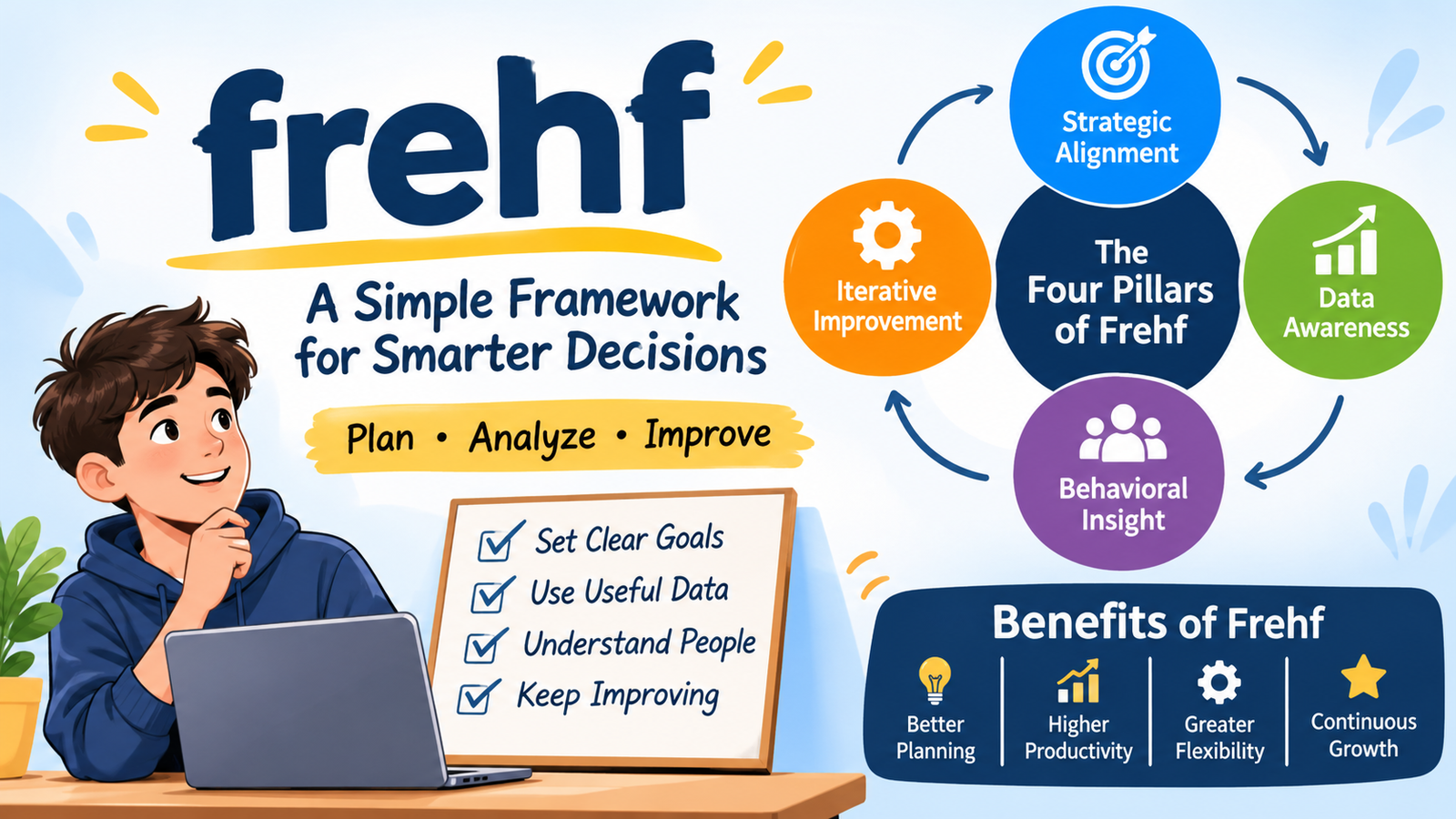
Frehf is an emerging term connected with structured thinking, productivity, adaptability, and better decision-making. People may encounter it while researching digital work, business planning, or modern productivity methods. The term can seem confusing because different websites describe it in different ways. Some sources connect it with a four-part framework, while others describe it as software or an AI-related system. The clearest historical description presents four connected ideas: Strategic Alignment, Data Awareness, Behavioral Insight, and Iterative Improvement.
The most useful way to understand frehf is to focus on the practical ideas behind the name. These ideas encourage people to set clear goals, study useful information, understand human behavior, and improve their methods over time. This article explains the concept in simple language. It also separates useful principles from claims that still lack strong independent evidence.
What Is Frehf?
Frehf can be understood as an emerging framework for organizing goals, decisions, and improvement. Its main purpose is to create more clarity when people face complicated tasks. Instead of treating every problem as a separate issue, the framework connects planning, information, human behavior, and continuous learning.
The concept is especially interesting because it does not require complicated technology. The historical Frehf description states that people can begin with simple tools, including pen and paper. This makes the basic approach easy to understand and test. However, readers should distinguish the framework from claims about a dedicated software platform. Current online evidence does not establish a single widely recognized Frehf application or technology product.
What Does Frehf Mean?
The exact meaning of frehf is not universally established. Several websites use the term in different ways, which makes careful wording important. One frequently repeated expansion is “Future-Ready Enhanced Human Framework.” However, available evidence does not establish this expansion as an official or universally accepted definition.
A more practical explanation comes from the four principles connected with the framework. These principles focus on aligning actions with goals, using relevant information, understanding people, and making improvements through repeated learning. That makes the concept easier to apply without depending on a particular acronym. It also avoids presenting an uncertain definition as established fact. When researching an unfamiliar online term, this distinction matters. A confident description does not automatically prove that the concept has academic recognition, independent testing, or widespread professional adoption.
Frehf at a Glance
| Category | Details |
|---|---|
| Name | Frehf |
| Type | Emerging framework or concept |
| Main focus | Clarity, decision-making, adaptability, and improvement |
| Core principles | Strategic Alignment, Data Awareness, Behavioral Insight, Iterative Improvement |
| Possible users | Individuals, creators, teams, and organizations |
| Special software required | Not required for the basic framework |
| Commonly discussed areas | Productivity, business planning, digital work, and process improvement |
| Official full form | Not independently established |
| Scientific validation | No independent validation established |
| Software status | No clearly established standalone application |
| Best approach | Treat specific claims carefully and evaluate practical results |
This overview is important because online discussions sometimes mix the framework with broader technology claims. Historical material presents the four-pillar approach, while newer sources caution that software, AI, and performance claims are not equally verified.
The Four Core Principles Behind Frehf
The four principles provide the clearest practical explanation of frehf. Strategic Alignment connects daily actions with meaningful objectives. Data Awareness encourages people to use useful information rather than guesswork. Behavioral Insight focuses on how people think, act, and respond to systems. Iterative Improvement encourages repeated testing and adjustment.
These ideas work together rather than operating as isolated steps. For example, imagine a content creator who wants to improve audience engagement. Strategic Alignment defines the desired result. Data Awareness examines useful performance information. Behavioral Insight considers what audiences respond to. Iterative Improvement then tests changes and reviews the results. This example shows how the framework can become a practical decision process without requiring special software or complicated terminology.
Strategic Alignment
Strategic Alignment means connecting everyday actions with a larger goal. It helps people decide what deserves attention and what can wait. Without clear alignment, a person may spend hours completing tasks that produce little meaningful progress.
For example, a small online business might have a goal of improving customer satisfaction. Instead of creating unrelated tasks, the team could focus on improving response times, reviewing customer feedback, and fixing common service problems. Each action would connect to the larger objective. This approach also helps teams understand why their work matters. The historical framework description places Strategic Alignment at the center of connecting goals, resources, and actions.
Data Awareness
Data Awareness means paying attention to information that can improve decisions. It does not mean collecting every possible number. Good data awareness involves finding signals that actually help answer a question.
Consider a website owner who notices that an article receives many search impressions but few visits. Instead of guessing, the owner can review the title, search intent, page structure, and audience behavior. The findings may suggest a useful change. The change can then be tested and reviewed. This process turns information into practical learning. The Frehf framework describes Data Awareness as making decisions from useful signals rather than unnecessary noise.
Behavioral Insight
Behavioral Insight adds the human side of decision-making. Numbers can show what happened, but they may not explain why it happened. Understanding people can reveal motivations, frustrations, habits, and obstacles that affect results.
Imagine a company introduces a new internal process. The numbers show that employees are not using it regularly. A purely technical response might add more instructions. A behavioral approach would first ask why people avoid the process. Perhaps it takes too long, feels confusing, or does not fit their daily routine. Understanding that friction can lead to a better solution. This principle makes the framework more human-centered because it recognizes that successful systems must work for real people.
Iterative Improvement
Iterative Improvement means making changes, observing results, and learning from what happens. It avoids the assumption that the first solution will always be perfect. Instead, progress happens through small adjustments.
For example, a content creator might test a different article structure. After publishing, the creator can review useful performance signals and reader responses. If the new structure works better, it can become part of the regular process. If it performs poorly, another version can be tested. This cycle creates a habit of learning. The historical framework describes Iterative Improvement as making small adjustments rather than relying on major changes all at once.
How Frehf Can Be Used in Business
Businesses can apply the four principles to planning, workflow improvement, customer service, and team coordination. The first step is identifying a meaningful business objective. The next step is selecting information that can help measure progress. Teams can then examine customer or employee behavior and test practical improvements.
For example, an online store could experience repeated customer complaints about delivery updates. Strategic Alignment would define better communication as the goal. Data Awareness would examine complaint patterns and delivery information. Behavioral Insight would consider what customers need during the waiting period. Iterative Improvement would test a clearer notification process. This example does not prove that the framework guarantees better business performance. Instead, it demonstrates how its principles can provide a structured way to approach a real problem.
Frehf for Digital Creators
Digital creators can also apply the same ideas to content planning and audience development. A creator might begin with a clear goal, such as producing more useful educational content. Data can then help identify which topics attract meaningful engagement. Audience behavior can reveal which formats are easier to understand.
The creator can then test small changes rather than changing everything at once. For example, a different introduction could be tested against an existing format. The creator could compare meaningful audience signals and decide what to improve next. This creates a simple learning loop. The value comes from the process itself rather than from assuming that the Frehf label automatically produces better content. That distinction keeps the approach practical and realistic.
Frehf for Personal Productivity
Individuals can use the principles for study, planning, personal projects, and everyday responsibilities. A notebook can be enough to create a simple system. First, write down the main objective. Next, identify the most important tasks. Then track useful information about progress.
Behavioral Insight can help identify personal obstacles. Perhaps distractions appear at certain times, or a task feels too large to begin. Breaking the task into smaller actions may make it easier to manage. Iterative Improvement then means reviewing the routine and making small changes. This approach can be useful because it turns productivity into a learning process. Instead of blaming yourself when a plan fails, you examine what happened and adjust the system.
Does Frehf Require Special Software?
The basic framework does not require special software. Historical information associated with Frehf specifically says that people can use simple tools such as pen and paper, with optional templates. This makes the underlying ideas accessible to individuals who do not want another complicated digital platform.
Some online articles have described frehf using software-style language, including interfaces, analytics, integrations, and AI-powered functions. However, available evidence does not establish one clearly documented commercial software product with those capabilities. Therefore, readers should not automatically treat every software claim as a confirmed feature. The framework and a supposed software implementation should be considered separate things unless reliable product documentation connects them.
Is Frehf an AI Tool?
There is no strong evidence establishing frehf as a recognized standalone AI tool. Some online descriptions connect the term with artificial intelligence, automation, and digital systems. Other sources present it primarily as a conceptual framework.
The distinction is important. A framework can be applied to AI-related work without itself being an AI product. For example, a team could use Strategic Alignment to decide why an AI system is needed. Data Awareness could help evaluate relevant information. Behavioral Insight could help understand user needs. Iterative Improvement could guide testing and refinement. This makes the framework potentially relevant to modern technology discussions without claiming that it contains a verified AI engine.
How Frehf Compares With Other Methods
Frehf can be compared with familiar approaches such as SMART goals, Agile, Scrum, OKRs, and PDCA. These methods already provide established ways to organize goals, projects, and improvement.
| Method | Main Focus | Typical Application |
|---|---|---|
| Frehf | Alignment, data, behavior, improvement | General structured thinking |
| SMART Goals | Specific and measurable objectives | Goal planning |
| OKRs | Objectives and measurable results | Organizational planning |
| Agile | Adaptability and collaboration | Product and project work |
| Scrum | Short development cycles | Team projects |
| PDCA | Plan, Do, Check, Act | Process improvement |
The key point is that the principles associated with frehf overlap with ideas already used in established approaches. Its value therefore depends on how clearly and consistently someone applies the ideas.
Benefits of Using the Frehf Approach
The potential benefit of frehf is its simple structure. It encourages people to connect goals with actions instead of treating every task separately. It also combines information and human behavior with continuous improvement.
Another benefit is flexibility. People can apply the principles to different situations without needing a specific industry or profession. A student, creator, manager, or small business owner can adapt the same basic process to a different goal. The approach also encourages regular reflection. That can help people notice when a plan is no longer working. However, these are practical advantages of the underlying principles. They should not be presented as guaranteed results produced by a scientifically validated system.
Limitations and Credibility Considerations
The biggest limitation is that the term does not have one universally established definition. Online sources describe frehf in noticeably different ways. Some connect it with a four-pillar framework, while others describe software, AI, or alternative meanings.
There is also limited independent evidence supporting claims that the framework itself produces specific productivity improvements. Therefore, statistics presented elsewhere should not automatically be treated as proven Frehf results. Readers should look for original studies, identifiable authors, documented case studies, and transparent methodology before accepting strong performance claims. This does not make the underlying ideas useless. It simply means they should be evaluated based on practical value rather than marketing language.
Is Frehf an Officially Recognized Framework?
Frehf is not currently established as a widely recognized academic, technical, or international industry standard. Available sources describe it as an emerging concept or framework, while independent validation remains limited.
That does not prevent people from exploring the ideas. Many useful working methods begin as simple concepts and develop through testing and adoption. However, readers should avoid confusing an emerging framework with a formally validated methodology. A careful approach is to use the principles in low-risk situations, measure the results, and decide whether they genuinely improve the workflow. This creates a more trustworthy way to evaluate the concept.
A Simple Way to Apply Frehf
A simple implementation can begin with one problem rather than an entire organization. Write down the desired outcome in one clear sentence. Then identify the information needed to understand the current situation. Next, consider the people involved and the behaviors affecting the problem.
After that, choose one practical change to test. Give the change enough time to produce useful feedback. Review what happened and decide whether to continue, modify, or replace the approach. This process creates a simple loop that mirrors the four principles. Starting small is often better than creating a complicated system immediately. It also makes results easier to understand because fewer variables change at the same time.
What Is the Future of Frehf?
The future of frehf will depend on clearer documentation, stronger evidence, and consistent use. If the concept develops further, readers may see more detailed examples, research, case studies, or practical guidance. Those developments would make it easier to understand what separates the framework from existing productivity and management methods.
For now, the most useful approach is to focus on its underlying principles. Strategic Alignment can clarify priorities. Data Awareness can improve decisions. Behavioral Insight can explain human factors. Iterative Improvement can encourage learning. These ideas have practical value even when the broader label remains emerging. Future recognition should come from transparent evidence and real-world results rather than repeated claims across websites.
Frequently Asked Questions About Frehf
1. What is Frehf in simple terms?
Frehf is an emerging term associated with a structured approach to goals, decisions, human behavior, and continuous improvement. The clearest framework description connects it with four pillars: Strategic Alignment, Data Awareness, Behavioral Insight, and Iterative Improvement.
2. What does FREHF stand for?
Some online sources expand FREHF as “Future-Ready Enhanced Human Framework.” However, this expansion has not been independently established as the official meaning. It is safer to describe it as a reported interpretation rather than a confirmed definition.
3. Is Frehf a software application?
There is not enough reliable evidence to describe frehf as one established software application. Historical material presents the concept as a framework that does not require special software. Some third-party articles make broader software claims, but those claims should be verified separately.
4. What are the four pillars of Frehf?
The four commonly associated pillars are Strategic Alignment, Data Awareness, Behavioral Insight, and Iterative Improvement. Together, they connect goals, useful information, human behavior, and repeated learning.
5. Can Frehf be used for personal productivity?
Yes, the principles can be applied to personal planning, study, content creation, and everyday projects. A person can use a notebook to define a goal, track useful information, identify obstacles, and make small improvements. This is an application of the principles rather than proof of guaranteed results.
6. Is Frehf a scientifically proven framework?
There is currently insufficient independent evidence to describe frehf itself as a scientifically validated framework. Some of its individual ideas overlap with established approaches to planning, behavioral understanding, data use, and continuous improvement. Readers should therefore evaluate specific claims using reliable evidence.
Conclusion
Frehf is an emerging online concept associated most clearly with four connected ideas: Strategic Alignment, Data Awareness, Behavioral Insight, and Iterative Improvement. These principles provide a simple way to think about goals, information, human behavior, and continuous learning. They can potentially be applied to business planning, digital creation, personal productivity, and process improvement.
At the same time, readers should separate the useful framework ideas from stronger claims about software, artificial intelligence, official recognition, or guaranteed performance. Current information does not provide enough independent evidence to treat every online description as established fact. The best approach is practical and careful: start with a clear goal, use relevant information, understand the people involved, test small changes, and measure what happens. That gives you a useful system while keeping your decisions grounded in evidence.
