




When people look up at the sky or see images of the sun in children’s books, artwork, or weather icons, one question often comes to mind: what color is the sun?
At first glance, the answer may seem simple—yellow. But scientifically speaking, the truth is far more fascinating.
In this detailed guide, we will explore what color the sun really is, why it appears different colors from Earth, how science explains its true color, and how human perception, atmosphere, and space affect what we see. This article is written in clear, SEO-friendly language and backed by physics, astronomy, and observational science.
What Color Is the Sun According to Science?
From a scientific perspective, the sun is actually white, not yellow.
The sun emits light across the entire visible spectrum—red, orange, yellow, green, blue, indigo, and violet. When all these colors combine evenly, they produce white light. Astronomers and physicists confirm that the sun’s natural color, when viewed from space without atmospheric interference, is white.
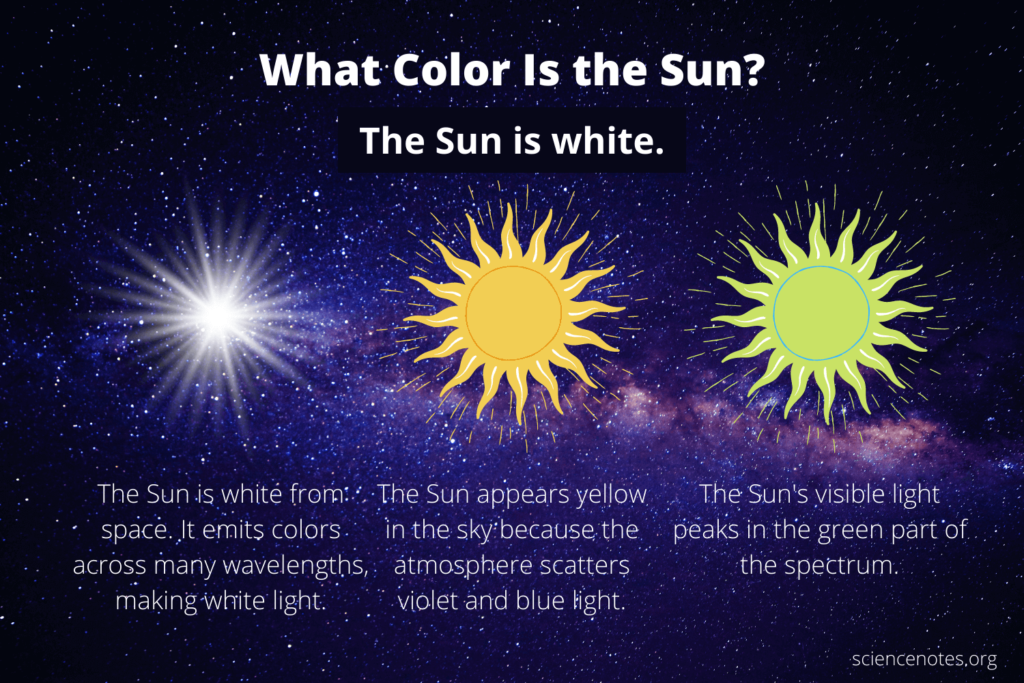
This fact surprises many people because popular culture, drawings, and even early science textbooks often describe the sun as yellow.
Why Does the Sun Look Yellow From Earth?
To understand what color is the sun as seen from Earth, we need to look at how Earth’s atmosphere affects sunlight.
When sunlight enters the atmosphere, it interacts with gases and particles. This process is called Rayleigh scattering.
- Shorter wavelengths (blue and violet) scatter more easily
- Longer wavelengths (red, orange, yellow) pass through more directly
Because blue light scatters in all directions, the sky appears blue. At the same time, the remaining direct sunlight reaching our eyes becomes slightly yellowish.
So, the sun appears yellow from Earth, even though its true color is white.
What Color Is the Sun in Space?
If you were an astronaut viewing the sun from space, outside Earth’s atmosphere, the answer to what color is the sun in space would be simple: white.
NASA images taken from space clearly show the sun as white. There is no atmospheric scattering to remove blue wavelengths, so all visible colors reach the observer equally.
This confirms that the sun’s yellow appearance is an optical effect caused by Earth’s atmosphere—not its actual color.
What Color Is the Sun at Sunrise and Sunset?
One of the most beautiful times to observe the sun is during sunrise and sunset. At these times, the answer to what color is the sun changes again.
During sunrise and sunset, the sun often appears:
- Orange
- Red
- Deep amber
This happens because sunlight travels through a much thicker layer of atmosphere at low angles. Most blue and green wavelengths scatter away, leaving red and orange tones dominant.
So, the sun does not change color—our viewing conditions change.
What Color Is the Sun Compared to Other Stars?
When discussing what color is the sun, it’s helpful to compare it with other stars.
The sun is classified as a G-type main-sequence star (G2V). These stars appear white or slightly yellowish.
Other stars appear different colors due to their temperatures:
- Blue stars: extremely hot
- White stars: very hot
- Yellow stars: medium temperature (like the sun)
- Orange stars: cooler
- Red stars: coolest
Even though the sun is called a “yellow star,” its actual emitted light is still white.
What Color Is the Sun Based on Temperature?
The surface temperature of the sun is approximately 5,500°C (9,932°F).
At this temperature:
- Objects emit a full spectrum of visible light
- The combined emission appears white
If the sun were cooler, it would appear redder. If it were hotter, it would appear bluish. The sun sits right in the middle, producing balanced white light.
This temperature-based explanation helps clarify what color is the sun in physics terms.
What Color Is the Sun in Photos and Images?
Many people notice that photographs of the sun show different colors—yellow, orange, red, or even white.
This variation depends on:
- Camera filters
- Exposure settings
- Protective solar filters
- Post-processing edits
Most solar telescopes use filters that highlight solar activity, making the sun appear red (hydrogen-alpha images) or orange. These images are not showing the sun’s true visible color but specific wavelengths.
What Color Is the Sun to the Human Eye?
The human eye plays a major role in how we perceive color.
Our eyes are more sensitive to yellow-green light. This sensitivity can slightly skew our perception, making the sun seem yellowish even when it’s emitting white light.
So when asking what color is the sun to humans, the answer depends on:
- Eye sensitivity
- Atmospheric conditions
- Brightness levels
Common Myths About What Color Is the Sun
Myth 1: The Sun Is Yellow
This is the most widespread myth. While the sun can appear yellow, it is not its true color.
Myth 2: The Sun Changes Color Daily
The sun does not change color. Changes in appearance are caused by atmospheric conditions and viewing angles.
Myth 3: Artists Are Wrong to Draw a Yellow Sun
Artists use yellow because it contrasts well with blue skies and is culturally familiar—not because it’s scientifically accurate.
What Color Is the Sun in Different Cultures?
Across cultures, the sun is often depicted in warm colors:
- Yellow in Western art
- Red in East Asian symbolism
- Gold in ancient civilizations
These representations are symbolic rather than scientific. They reflect warmth, life, power, and energy rather than actual color.
What Color Is the Sun and Why It Matters in Science
Understanding what color is the sun is more than curiosity—it helps scientists study:
- Stellar classification
- Light behavior
- Atmospheric physics
- Climate science
- Solar energy efficiency
Solar panels, for example, are designed to absorb the sun’s full spectrum, not just yellow light.
What Color Is the Sun and the Blue Sky Connection
The question what color is the sun is closely tied to why the sky is blue.
Both phenomena are explained by Rayleigh scattering:
- Blue light scatters → blue sky
- Remaining light → yellowish sun appearance
This interconnection helps students and learners understand Earth’s atmosphere more clearly.
What Color Is the Sun According to NASA?
NASA confirms that the sun is white when observed from space. Official NASA imagery and scientific explanations support this conclusion, reinforcing the idea that yellow is an illusion caused by Earth’s atmosphere.
Frequently Asked Questions About What Color Is the Sun
Is the sun white or yellow?
Scientifically, the sun is white. It appears yellow due to atmospheric scattering.
Why do children learn that the sun is yellow?
Simplification, cultural imagery, and ease of recognition play a role in early education.
Can the sun appear blue or green?
Rare atmospheric conditions can cause unusual color effects, but these are optical illusions.
Is it safe to look at the sun to check its color?
No. Never look directly at the sun without proper eye protection.
Final Thoughts: What Color Is the Sun Really?
So, what color is the sun?
- In space: White
- From Earth: Yellowish
- At sunrise/sunset: Orange or red
- Scientifically: White
The sun’s true nature is far more complex and fascinating than a single color. Its appearance depends on physics, atmosphere, perception, and perspective.
Understanding this not only answers a common question but also opens the door to deeper knowledge about light, stars, and our universe.
