



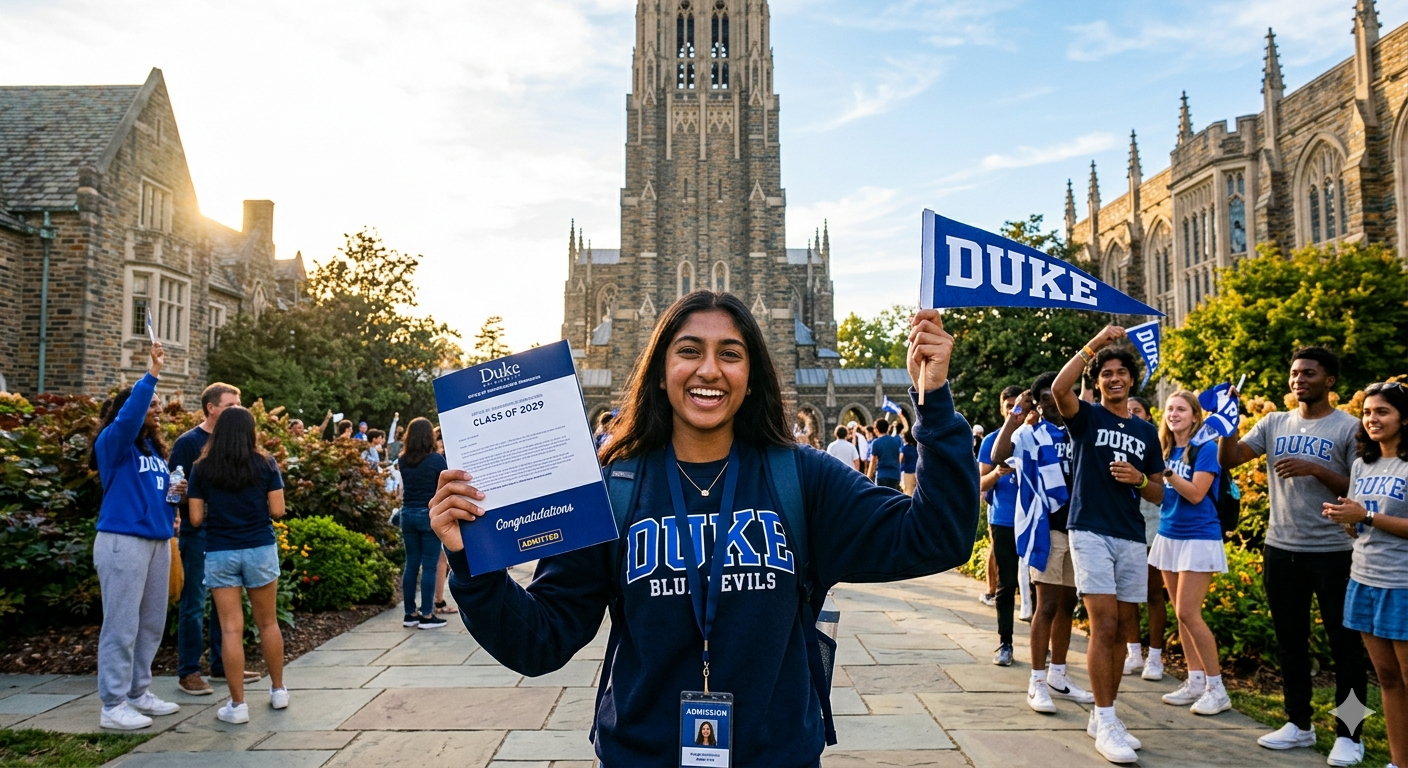
Are you dreaming of becoming a Blue Devil? Walking through the beautiful gothic campus in Durham, North Carolina, is a goal for thousands of students every year. But before you pack your bags, it is important to understand the numbers. The Duke acceptance rate has become one of the most competitive in the world. In fact, getting into Duke University is now just as hard as getting into many Ivy League schools!
Applying to a top-tier college can feel like a big mystery. You might wonder if your grades are high enough or if your SAT scores will make the cut. Don’t worry! In this guide, we will break down the latest admission statistics, explain what the school looks for, and give you real tips to help your application shine. Let’s dive into what it really takes to get that “Yes” from Duke.
Understanding the Duke Acceptance Rate for 2025
The most recent data for the Class of 2029 shows a record-breaking year. The Duke acceptance rate dropped to a historic low of approximately 4.8%. This means that out of over 58,000 students who applied, only a small fraction received an admission letter.
Why is it so low? Over the last decade, the number of people applying has skyrocketed. While the university still only has about 1,700 to 1,800 seats for freshmen, more students from across the globe are trying to get in. This “supply and demand” problem makes the Duke University admission rate much tougher than it used to be. Just a few years ago, the rate was closer to 7% or 8%. Now, the competition is fiercer than ever.
Early Decision vs. Regular Decision: Which is Better?
If you are serious about Duke, you need to know the difference between Early Decision (ED) and Regular Decision (RD). The Duke acceptance rate changes a lot depending on when you apply.
- Early Decision (ED): This is for students who know Duke is their #1 choice. If you get in, you must attend. The acceptance rate here is usually much higher, around 12.8% to 13.8%.
- Regular Decision (RD): Most students apply this way. Because the pool of applicants is so large, the acceptance rate drops significantly to about 3.7% to 4.1%.
By applying early, you show the school that you are truly committed. While the standards for your grades are still very high, the math shows you have a better statistical chance in the early round.
Academic Standards: GPA and Test Scores
Duke is looking for the “best of the best.” To be competitive, your academic profile needs to be nearly perfect. While the school is currently test-optional, meaning you don’t have to send SAT or ACT scores, most successful applicants still do.
Most students admitted to Duke have a GPA of 4.0 or higher (weighted). They aren’t just taking easy classes, either. The admissions team wants to see that you took the hardest courses available at your school, like AP, IB, or Honors classes. For testing, the middle 50% of students usually score between 1520 and 1570 on the SAT or 34 and 36 on the ACT. If your scores are in this range, you are in a great spot!
Important Admission Statistics at a Glance
| Category | Data for Class of 2029 |
| Total Applicants | 58,712 |
| Overall Acceptance Rate | 4.8% |
| Early Decision Rate | ~13.8% |
| Regular Decision Rate | ~3.7% |
| Average SAT Range | 1520–1570 |
| Average ACT Range | 34–36 |
| International Students | ~13% of the class |
What Does Duke Look for in a Student?
It’s not just about the numbers! If everyone has a 4.0 GPA, how does the school choose? This is where holistic review comes in. Duke looks at the “whole person.” They want to see Experience, Expertise, Authoritativeness, and Trustworthiness in your personal story.
They look for students who have a “spark.” Maybe you started a local charity, lead a varsity sports team, or are an expert in coding. They value diversity and students who will contribute to the campus community. Your application essays are the best place to show your personality. Don’t just write what you think they want to hear—write about what truly makes you happy and motivated.
The Role of Extracurricular Activities
Your life outside the classroom matters a lot. Duke loves to see “depth over breadth.” This means they would rather see you do one or two things really well for four years than join ten clubs for just one month.
Whether it is music, science research, or community service, show how you have made an impact. Did you lead others? Did you solve a problem? Real-world examples of your leadership can significantly boost your chances, even when the Duke acceptance rate feels intimidating.
Tips for Writing Your Duke Supplemental Essays
The “Why Duke?” essay is your chance to prove you belong. To rank well in their minds, you need to be specific. Don’t just say “Duke has great buildings.” Instead, talk about specific professors you want to work with or clubs like the Duke Impact Network that you want to join.
- Be Personal: Share a story that only you can tell.
- Be Specific: Mention campus traditions like “tenting” for basketball games.
- Show Growth: Talk about how you have overcome a challenge.
- Proofread: Simple mistakes can hurt your “trustworthiness” as a serious applicant.
Financial Aid and Accessibility
One great thing about Duke is its commitment to being need-blind. This means they don’t look at how much money your family has when they decide to admit you. If you are a talented student, they want you there!
Duke also has the Carolinas Financial Aid Initiative, which helps students from North and South Carolina specifically. They promise to meet 100% of your demonstrated financial need. This makes a world-class education possible for everyone, regardless of their bank account balance.
Comparing Duke to Other Elite Universities
How does Duke stack up against the Ivy League? With a Duke acceptance rate of 4.8%, it is now more selective than schools like Cornell, Dartmouth, and even the University of Pennsylvania.
Duke offers a unique mix of “work hard, play hard.” You get the top-tier academics of a school like Harvard, but you also get the high-energy school spirit of a major sports school. This balance is why so many people are willing to face the low odds to get in.
Conclusion
The journey to college can be stressful, but remember that the Duke acceptance rate is just a number. While it is very low, someone has to be in that 4.8%—so why not you? Focus on keeping your grades high, being a leader in your community, and writing an essay that shows your true heart.
My personal advice? Don’t let the stats scare you. Use them to prepare. Start your application early, ask for recommendation letters from teachers who truly know you, and stay positive. You’ve got this!
Frequently Asked Questions
1. Is Duke an Ivy League school?
No, Duke is not technically in the Ivy League, but it is often called a “Hidden Ivy” or “Southern Ivy” because its academic reputation and selectivity are just as high.
2. Can I get into Duke with a 3.5 GPA?
It is very difficult. Most admitted students are in the top 10% of their high school class with GPAs above 3.9. However, a 3.5 could be overlooked if you have a world-class talent or a very unique story.
3. Does Duke care about the SAT anymore?
Duke is “test-optional” for the current cycle. This means you aren’t required to send scores. However, if you have a high score (1500+), sending it will definitely help your application.
4. What is the Duke transfer acceptance rate?
Transferring is even harder than applying as a freshman. The Duke transfer acceptance rate is usually around 3% to 8%, depending on the year.
5. How many letters of recommendation do I need?
Duke requires one counselor recommendation and two teacher recommendations. It is best to choose teachers who can speak to your curiosity and character.
6. Is an interview required for Duke?
Interviews are optional and based on the availability of alumni in your area. If you are offered one, you should definitely take it! It’s a great way to add a human touch to your file.
Conclusion
While the Duke acceptance rate might look intimidating at first glance, remember that these numbers represent a diverse group of individuals, not just a set of statistics. Duke University isn’t just looking for perfect test scores; they are looking for students who will bring life, passion, and new ideas to the Durham community. Whether you are cheering in the student section at a basketball game or conducting research in a world-class lab, the goal of your application is to show how you fit into that vibrant picture.
If you are ready to take the next step, start by focusing on what you can control right now: your grades, your leadership roles, and your unique story. The road to a 4.8% acceptance mark is narrow, but it is paved with preparation and authenticity. Stay organized, meet your deadlines, and most importantly, let your true personality shine through in every paragraph you write. We wish you the best of luck—hopefully, we’ll see you wearing the Blue Devil blue very soon!
